Matilda's Story: Rescued Stray Changes Lives of Autistic Children

Updated: Jun 30
How a rescued stray became a working partner in a classroom for children on the autism spectrum
Some of the most important members of a team arrive by accident. Matilda was found as a stray during an ordinary lunch break — no microchip, no one searching for her. The special educator, Necia, who found her brought her home when no one came forward. Neither of them knew it yet, but Matilda was about to go to work.
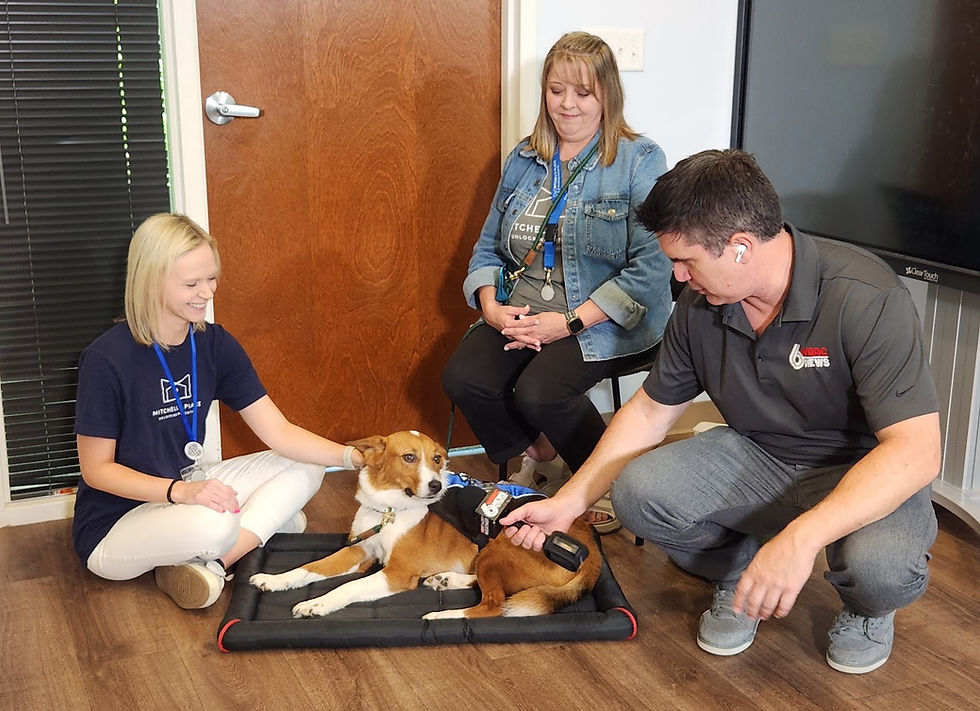
Today she spends her days at Mitchell's Place, a Birmingham center serving children on the autism spectrum, where she helps young learners build language, motor skills, confidence, and calm. Her story has become one of our favorite illustrations of a principle at the heart of everything we do at Three Dimensional Dog: you rarely need a different dog. You need to learn to train the dog you have to be the dog you need.
A problem worth solving
The journey began with a family. Mitchell's Place had been serving a child with autism whose family had made the painful decision to rehome their own dog after an aversive interaction with their son. The dog was gone — but the companionship wasn't forgotten. The older sibling especially missed having a dog in the home. And the educator working with the family could see something on the horizon: this child was preparing to transition into a public kindergarten that happened to have a therapy dog on campus. If he could learn to feel safe and confident around a dog now, that transition would be far gentler later.
The center applied for grants to fund a facility dog. Over the following year, the answers came back: not selected. Meanwhile, graduation was approaching and the window was closing. So the educator and our own Aaron McDonald with Three Dimensional Dog made a decision to personally fund the training. This was an effort that had to happen, and money wasn’t going to stand in the way.
Education, not tricks
Here's what's easy to miss about a dog like Matilda: the skills people notice — the sitting, the waiting, the gentle visits — are the last layer, not the first.
A facility dog working among children who may be dysregulated, loud, fast-moving, or in distress has to be something more fundamental than just "trained." She has to achieve security in a dynamic environment. In the language of our Unified Theory, we establish security through leadership, boundaries, and acclimation. A dog who is anxious, over-aroused, or unsure of her role can't offer calm to anyone — she's too busy managing her own world.
So the work began where it always begins in our model: clearing the slate of low-level anxiety and giving Matilda absolute clarity about her job and her handler's leadership. Only then could she become a reliable source of regulation for the children around her.
What Matilda does all day

Once that foundation was in place, the possibilities opened up. The team at Mitchell's Place has woven Matilda into nearly every part of their day — and the results are remarkable.
She gives children a reason to use their voice. Kids practice requesting by asking Matilda to "come," "sit," or fetch a ball — and they are thrilled when she actually listens. That thrill is the whole point. A child who is hesitant to speak suddenly has a powerful, joyful reason to. The same partnership supports labeling skills (pointing to her ears, paws, and tail) and listening skills ("point to the dog's nose").
She makes safety into a game. Elopement — a child wandering or bolting — is a serious concern for many families. Matilda turns that lesson into play with "Who Is the Better Listener?", where children practice "stop," "wait," and "come" right alongside her. The hope is to eventually bring parents into this activity so the skill can travel out into the community, where it matters most.

She motivates the body, not just the mind. One child working toward mobility goals received a new walker, and the daily motivation to travel all the way down the hall to see Matilda has become a powerful driver of his progress. Her picture lives on his visual schedule, helping him understand the predictable sequence of his day, and he regularly requests "dog" on his communication device. Other children build fine motor control opening canisters and treat bags, and learn to chain steps together — wash hands, hang the coat — with time alongside Matilda as the reward at the end.
She teaches social and emotional fluency. Children talk through feelings they share with her: happy, sleepy, nervous (Matilda, it turns out, doesn't love thunder either). They learn how to safely approach a dog, take turns, model commands for one another, and use her as a shared point of focus that draws out eye contact and joint attention between peers.
And she helps everyone come back to calm. Sometimes, when the usual de-escalation strategies aren't landing, simply watching Matilda walk past is enough of a reset to bring a child back to center. She serves as a line leader and a visual guide between classrooms, smoothing the transitions that are so often the hardest part of the day. Deep pressure therapy — resting her body across a child's lap to provide grounding sensory input — is still in development as Matilda continues her education, with more to come.
It isn't only the children, either. Staff stop by every day to sit with her for a few minutes and consistently say the same thing: having her there helps them feel calm, too.

The ripple effect
Remember the family that set all of this in motion — the one that had to rehome their own dog? The child who was once uneasy around dogs is now comfortable in their presence. He has found confidence in his own voice and in his ability to guide a dog through commands. His family has welcomed a new dog into their home — one who is also being educated through Three Dimensional Dog’s highly effective parenting techniques. And his team now feels confident he's ready to accept the therapy dog waiting for him in his kindergarten classroom.
One secure dog. One devoted educator willing to invest in her. And a circle of impact that widened to reach an entire family, a roomful of children, and the adults who care for them.

Why this story matters to us
Matilda embodies the future Three Dimensional Dog is building toward. Our mission has never been confined to fixing problem behaviors — it extends to the role dogs can play in human wellbeing, including dog-assisted support for mental health, learning, and connection and our innovative Train-at-Home service dog programs that upskill family pets to full-fledged, ADA-qualified service dogs. This is parent-training at its most expansive. When a person learns to truly understand and lead a dog, the dog becomes capable of things no amount of "obedience" alone could produce.

Matilda also reminds us that the dog who changes everything is so often the one already in front of you — the stray on a lunch break, the rescue at the shelter, the family pet who just needs a different kind of leadership. They are sent to us for a reason. You don't have to wait for the perfect dog. You already have one.
Three Dimensional Dog is a canine behavior and parent-training consultancy based in Birmingham, Alabama, founded by canine behaviorist and author Aaron McDonald. To learn more about our approach — including service and facility dog education — visit threedimensionaldog.com.


Uploaded pixel art of my cat and got a clean nonogram puzzle with solvable clues. Rare to find a generator that actually checks for a unique solution.